A look inside the data
Every record ties an image to a viewer
Each image carries its topic, message, strategy, and framing — paired with the annotator's persuasiveness score and full psychological profile.
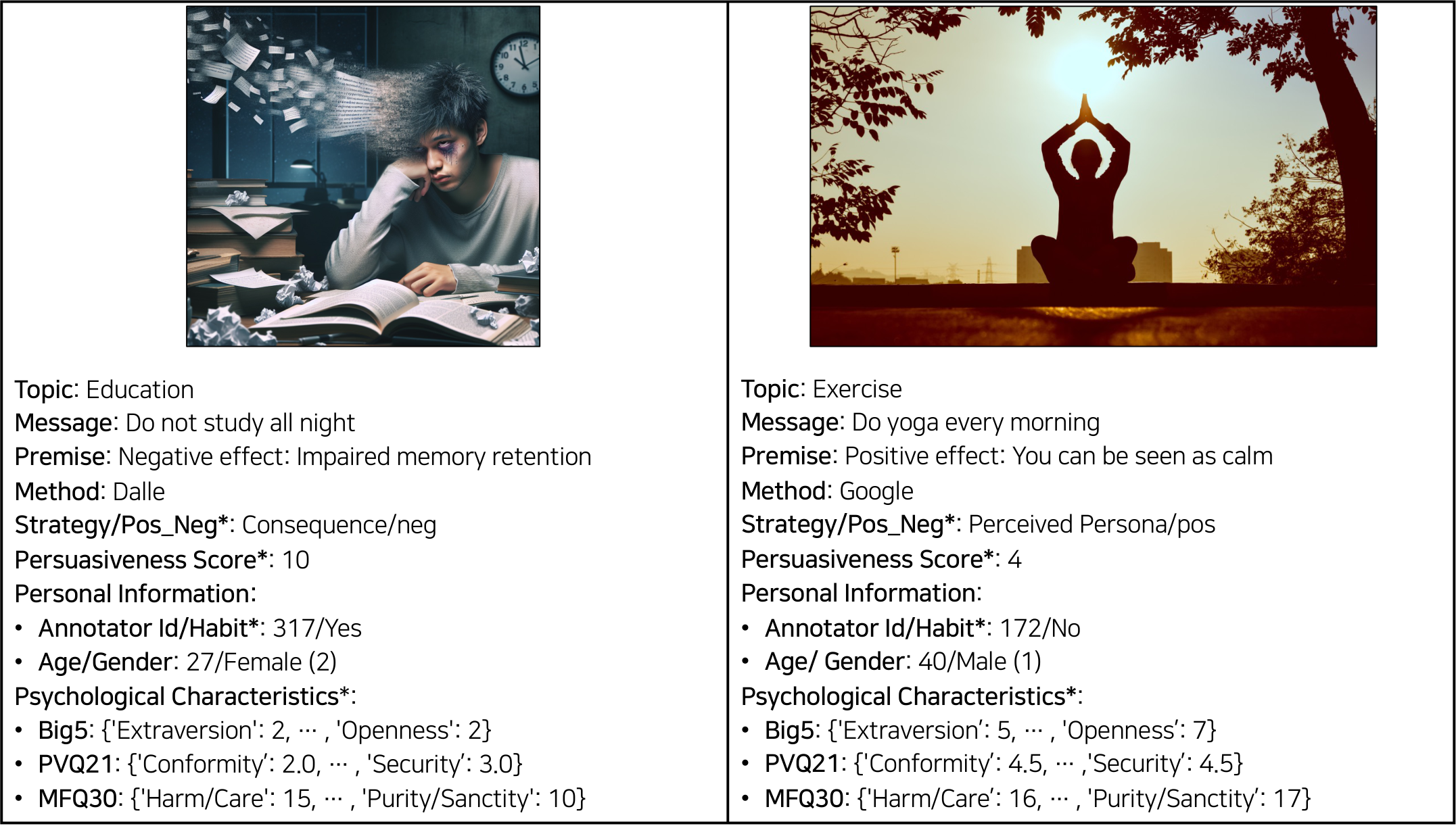
Persuasion strategies, viewer characteristics, and persuasiveness ratings — connecting what an image shows with who is looking.
Motivation
Suppose you want to exercise regularly but lack motivation. Which image would make you more likely to work out? One may be more persuasive for someone who prioritizes safety, while another resonates with someone who values self-improvement and how others perceive them.
A key factor is human values: persuasive content appeals to the values a particular viewer prioritizes in life. Building on this, how can we develop personalized AI agents that generate persuasive messages and visuals tailored to each user — not just to communicate information, but to help each user take action and achieve their goals?
PVP is a step toward that goal: it connects what an image shows with who is looking — their demographics, habits, personality, and values.
Visual persuasion, which uses visual elements to influence cognition and behaviors, is crucial in fields such as advertising and political communication. With recent advancements in artificial intelligence, there is growing potential to develop persuasive systems that automatically generate persuasive images tailored to individuals. However, a significant bottleneck in this area is the lack of comprehensive datasets that connect the persuasiveness of images with the personal information about those who evaluated the images. To address this gap and facilitate technological advancements in personalized visual persuasion, we release the Personalized Visual Persuasion (PVP) dataset, comprising 28,454 persuasive images across 596 messages and 9 persuasion strategies. Importantly, the PVP dataset provides persuasiveness scores of images evaluated by 2,521 human annotators, along with their demographic and psychological characteristics (personality traits and values). We demonstrate the utility of our dataset by developing a persuasive image generator and an automated evaluator, and establish benchmark baselines. Our experiments reveal that incorporating psychological characteristics enhances the generation and evaluation of persuasive images, providing valuable insights for personalized visual persuasion.
Dataset at a glance
Concrete, actionable behaviors (e.g. “Do not smoke”) drawn from the 15 U.S. executive departments plus 5 under-represented agency topics — wide, real-world coverage rather than niche debates.
Each premise becomes both a DALL·E prompt and a Google Image Search query. After rigorous human + GPT filtering, intuitive situational images remain — no dense text or symbolism required.
Annotators recruited evenly across genders and ages (20s–50s). Every rating comes with demographics, whether they already practice the behavior (habit), and three psychological profiles.
Topics & messages
Each topic groups concrete, actionable target behaviors. Fifteen topics are grounded in the U.S. executive departments; five more cover other everyday domains.
Persuasion strategies
Grounded in the theory of planned behavior, argumentation theory, and gain/loss framing. Four appeals split into positive and negative frames; Bandwagon stays single — nine strategies in total.
How others would perceive the viewer's persona or attributes.
Emotional reactions the viewer may personally experience.
Emotional responses that other people may experience.
Outcomes beyond persona or emotion (e.g. harms, wealth).
How popular the target behavior is among other people.
Who is looking
Openness, conscientiousness, extraversion, agreeableness, and neuroticism — traits shown to shape susceptibility to persuasion.
Ten universal values — power, achievement, hedonism, security, benevolence, and more — measured with the 21-item portrait questionnaire.
Care, fairness, loyalty, authority, and sanctity — the moral intuitions that guide how people weigh persuasive appeals.
How the data was built
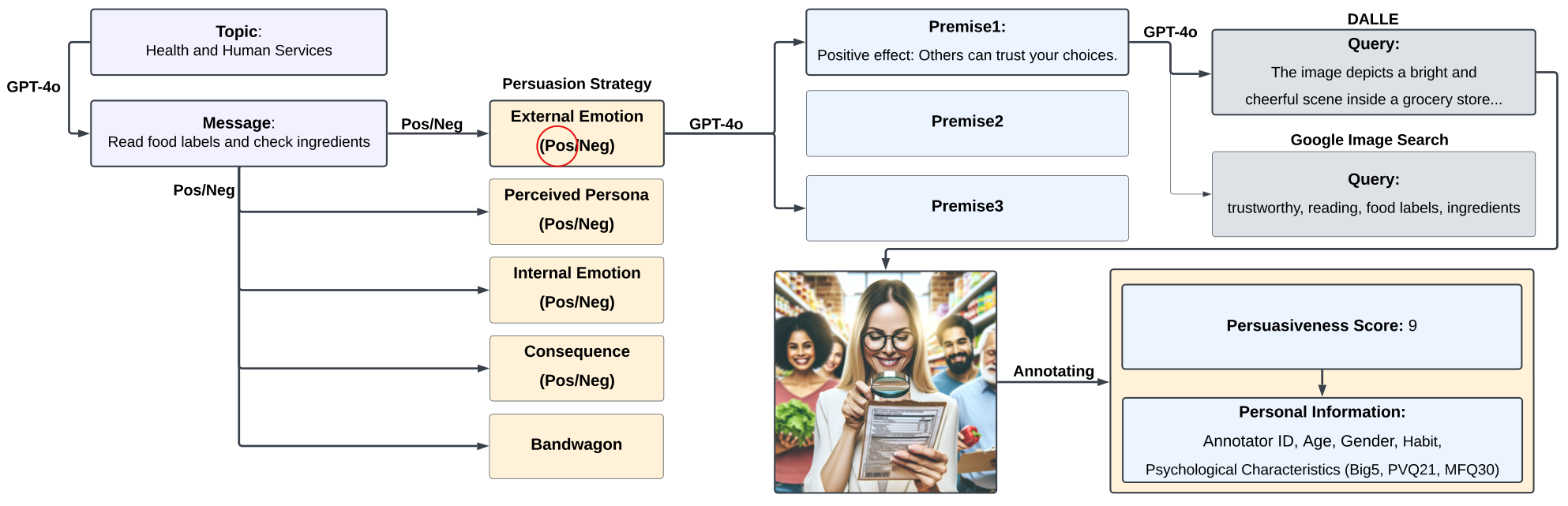
GPT-4o generates 28–30 target behaviors per topic, then 27 strategy-specific premises for each message.
Every premise becomes a DALL·E prompt and a Google query — 54 candidate images per message, then human + GPT filtering.
Four annotators rate each image 0–10, then complete BFI-10, PVQ-21, MFQ-30, and report habit and demographics.
Two new tasks & baselines
Given a message and the target viewer's psychological characteristics, generate an image description tailored to persuade that specific person.
Predict how persuasive an image is for a given viewer — a consistent automated metric for building and comparing generators.
What the data reveals
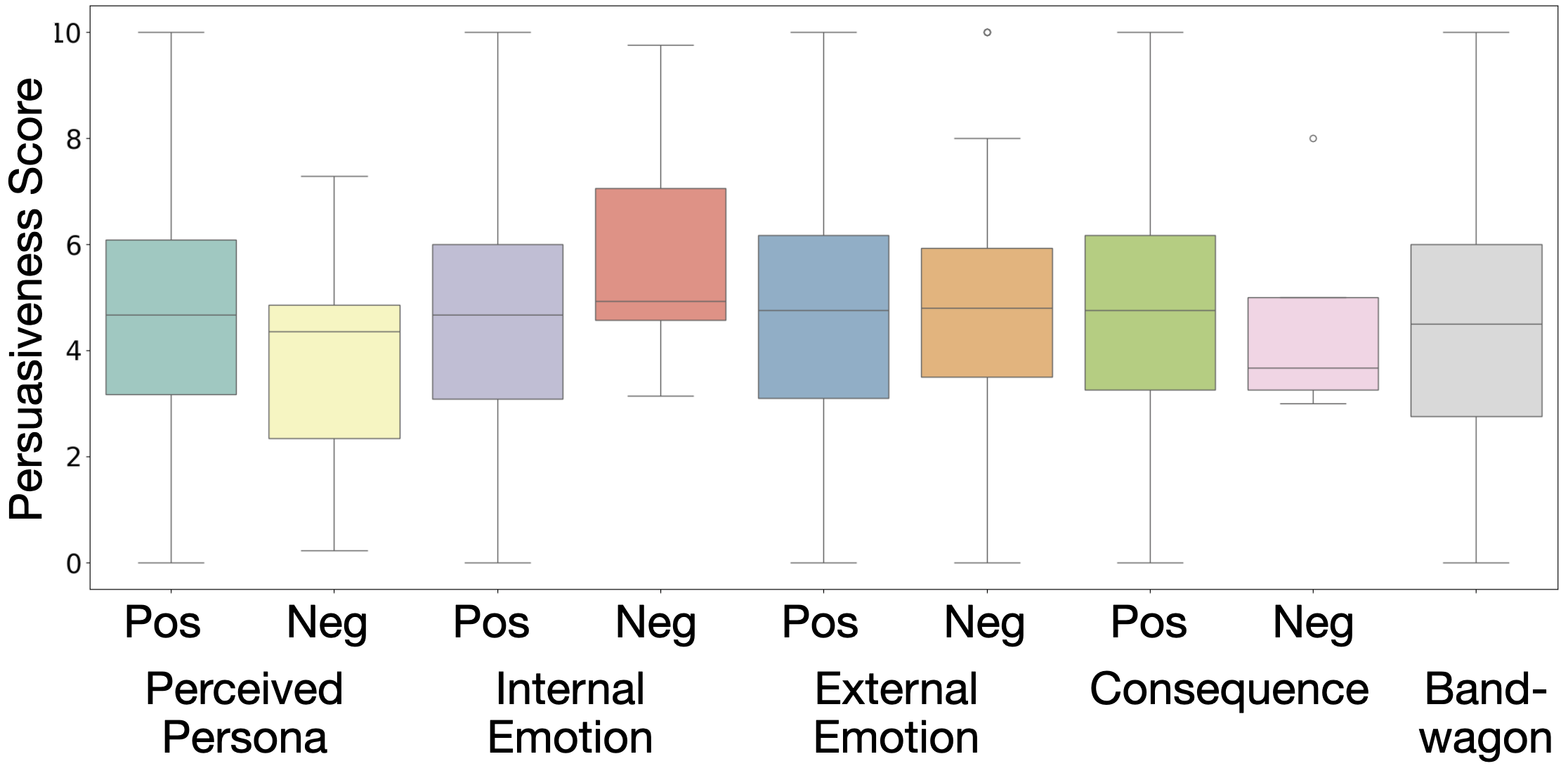
It earned the highest average score (5.83); negative perceived persona the lowest (3.73). Direct emotional appeals beat threats to public image.
Gain-framed strategies tended to out-persuade loss-framed ones — uplifting images engage and motivate viewers more reliably.
Viewers who value pleasure respond to loss-framed consequences — while the same frame back-fires for those high in stimulation or moral care.
Emotionally sensitive viewers are moved by guilt and anxiety appeals; highly conscientious viewers are not. Who is looking matters.
Citation
@inproceedings{kim-etal-2025-pvp,
  title     = "{PVP}: An Image Dataset for Personalized Visual Persuasion with
               Persuasion Strategies, Viewer Characteristics, and
               Persuasiveness Ratings",
  author    = "Kim, Junseo and Han, Jongwook and Choi, Dongmin and
               Yoon, Jongwook and Lee, Eun-Ju and Jo, Yohan",
  booktitle = "Proceedings of the 63rd Annual Meeting of the Association
               for Computational Linguistics (ACL)",
  year      = "2025"
}